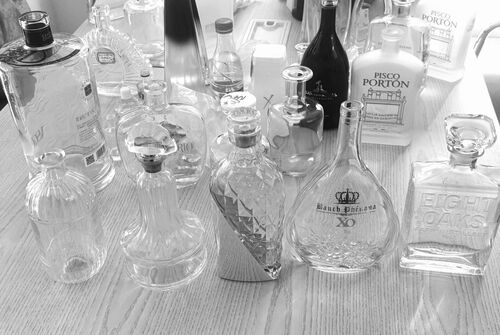
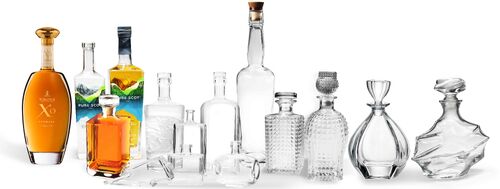
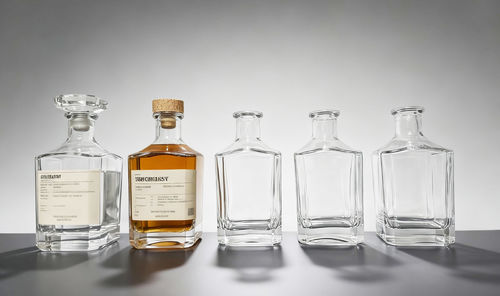
Chongqing Jewhui Glass Packaging Co., Ltd. is producing the most technically demanding bottles, mostly in the spirit segment, from one of the clearest glasses in the world and offers an extensive range as a full - service solution partner, from the idea, design, development, and production. Being made of top - quality glass, products are acclaimed for their perfect crystal shine and are completely free of heavy metals. All items can be customized through comprehensive decoration techniques.
Title: Spirits Bottle Mouth Finish Perpendicularity
– The First Critical Step in Filling & Sealing
In spirits production lines, a bottle's "looks" matter, but there's one invisible,
untouchable parameter that determines success or failure: bottle mouth perpendicularity.
This is especially critical for non-standard bottle shapes. It directly affects filling efficiency,
capping integrity, and whether leakage or cap jump occurs during transport.
So, what is bottle mouth perpendicularity? Simply put, it refers to the straightness of the
bottle mouth's central axis from 0mm to 16mm down from the top rim. The smaller the deviation,
the more reliable the seal. If the deviation is too large, even the best cap won't prevent leaks.
Here's our systematic approach to controlling this parameter in five steps:
1. Front-End Control: Digital Inspection + Process Adjustment
Control begins before the bottle is even formed. We use digital inspection equipment to
pre-assess bottle mouth dimensions during forming. If we find that a batch doesn't
match the customer's cap specifications (e.g., poor fit with cork or polymer caps), we immediately adjust:
· Forming temperature and temperature differences
· Mold dimensional parameters
· Machine power and timing sequences
This "inspect-then-adjust" approach eliminates problems at the source.
2. Post-Annealing: Automated Lab Re-Inspection
After annealing (to remove internal stress), bottles go to the lab for automated perpendicularity testing,
focusing on the 0–10mm range. This serves as a "mid-term exam" to catch any fine deformations caused
during the annealing process.
3. In-Line 100% Inspection: Full-Angle Automated Testing
For high-volume, standard products, we use fully automatic inspection machines to achieve 360° full-angle
testing. From the top rim down to 16mm, every angle is checked. This is not sampling—every single bottle
must pass independently.
4. Transport Sealing Traceability: Beyond Perpendicularity
Passing perpendicularity tests doesn't guarantee complete safety. During long-distance transport,
temperature changes cause pressure fluctuations inside the bottle. If perpendicularity deviates locally
at specific points (e.g., at 7mm or 12mm depth), "cap jump" can occur—the cap loosens or even pops off.
That's why we've established a multi-dimensional dimensional traceability system, recording perpendicularity
data at these critical cross-sections:
· 4mm position
· 7mm position
· 12mm position
· 16mm position
Every batch can be traced back to actual measurements at these four points, ensuring straightness
remains controllable across the entire capping height range.
5. Matching Different Cap Materials – Closing the Delivery Loop
Different customers use different cap materials: natural cork, synthetic polymer corks, plastic tamper-evident caps, etc.
Each has a different sensitivity to bottle mouth perpendicularity. Based on each customer's specific fit tolerances,
we set reverse-engineered inspection standards. This truly achieves "one customer, one standard."
Ultimately, what we deliver to customers is not just a good-looking spirits bottle, but one with controllable
straightness from 0mm to 16mm, reliable sealing performance, and the ability to withstand long-distance
transport and temperature fluctuations.
Perpendicularity control is, at its core, a commitment to certainty. Every millimeter of straightness is a promise
to the safety of the liquid inside.
#SpiritsBottling #BottleMouthPerpendicularity #LeakagePrevention #DigitalQualityInspection #SealingReliability
Chongqing Jewhui Glass Packaging Co., LtdUtilizing more than one decoration technology can
unlock extended packaging
opportunities and deliver the desired brand perception. One bottle can combine acid
etching, a transparent window, and silk screen printing with paints, including gold or platinum
containing materials.
* Screen printing
* Color-painting
* DEBOSSING AND EMBOSSING
* METALLIZATION
* HOT STAMPING
* Frosting
* Sand blasting
* Vacuum Metallization
* Metal ZINC-ALLOY PARTS
Customized Metal Zinc Alloyed Parts
For Extra White Flint Glass Bottle
The customized metal alloy part can be added to the bottle
as a logo or a cover to metal top , giving the bottle an
ultimate high-end and luxurious look.
Choosing the Right White Flint Glass Bottle for Your Product
Choosing the right glass bottle for your product is a critical part of the packaging process, as it has a significant impact on how consumers perceive your brand.extra white flint glass bottle The type of glass you choose conveys an image of luxury, sophistication, and premium quality, which can either enhance or detract from consumer perceptions. Considering your product’s needs, brand identity, and target market expectations, you can choose the perfect glass bottle for your business.
Regular white flint glass bottles, also known as standard flint or soda ware, are a popular choice for a variety of products.extra white flint glass bottle They strike a balance between clarity, durability, and affordability, making them suitable for businesses that prioritize cost-efficiency without compromising on essential functionality. They’re ideal for a wide range of beverages, food items, and even personal care products. While standard flint glass doesn’t boast the high level of clarity and brilliance that premium options like super flint or extra flint glass do, it still offers adequate transparency to showcase the contents of your bottle effectively.
While there are plenty of benefits to choosing a standard flint glass bottle for your product, it’s important to note that the material can have a negative effect on some product ingredients.extra white flint glass bottle For example, the chemical compounds responsible for wine’s aroma can be degraded by light exposure, which can alter the sensory experience of your beverage. The good news is, there are a number of ways to mitigate these effects.
To protect wine and other alcohols from degradation, many producers opt for bottle colors that can shield them from harmful UV rays. Traditionally, darker greens and other hues have been used for red wines, while lighter-colored glass is commonly used for roses and whites. These colors offer some protection against UV rays, but they don’t do much else to protect the products inside.
In the single point experiment, wines housed in flint glass experienced an average loss of 7% of their safranal concentration after 7 d of light exposure, while wines housed in colored glass saw a much steeper decline (SI Appendix, Fig. S23). Similarly, in the kinetic experiment, Pinot gris and Chardonnay wines housed in flint bottles lost about 66% of their safranal concentration after 90 d of shelf life, while similar values were registered for wines housed in colored glass.
The best way to minimize damage caused by light exposure is to use glass bottles with high-quality manufacturing processes that maximize transparency and brilliance. In addition, reputable glass bottle suppliers can incorporate customization techniques to elevate your brand’s presentation and further distinguish it on the shelf. Valiant Glass, for instance, offers a wide range of bottle finishes and customization options to create packaging that stands out on the shelves. Contact us today to learn more about the possibilities for your next project!
Tags:vodka flint glass bottle | whiskey glass bottle
Hot Stamping Golden Foil or Silver Color Advantages:
Many colors available, easy to operate, relatively eco-friendly, very firm on the glass. Typically gold and silver to give the logo or design pattern a metallic shining and luxurious feeling. Permanent effect can last for years.
JewhuiGlass has the expertise to meet the needs of all spirits producers types from
craft distilleries to global brands.The bottle is one of the features that makes your
brand stand out from the shelves. Contact our spirit specialists so that we can help
you elevate your brand.